Unitywater has made its Part 2 submission to the Queensland Competition Authority (QCA) as part of the Queensland Government’s price monitoring investigation.
The submission sets out our forecast prices, what they could mean for customer bills, and our expected revenue, expenditure and service outcomes for 2027–28 to 2029–30.
Our approach is focused on keeping prices as affordable as possible while continuing to provide safe and reliable water and wastewater services, investing in infrastructure for one of Australia’s fastest-growing regions and maintaining the long-term sustainability of our services.
Visit the QCA price monitoring webpage
On this page you’ll find information on:
What our Part 2 submission means for customers
Unitywater’s Part 2 submission sets out how we plan to balance affordable bills, reliable services and the infrastructure investment needed to support a rapidly growing region. For our customers, this means continuing to safely deliver the essential services you rely on today, while investing for future needs and keeping a close focus on efficiency and affordability.
We will continue to provide safe, clean drinking water
Providing safe, clean drinking water remains at the heart of our service. We are forecasting continued strong water quality performance throughout the price monitoring period.
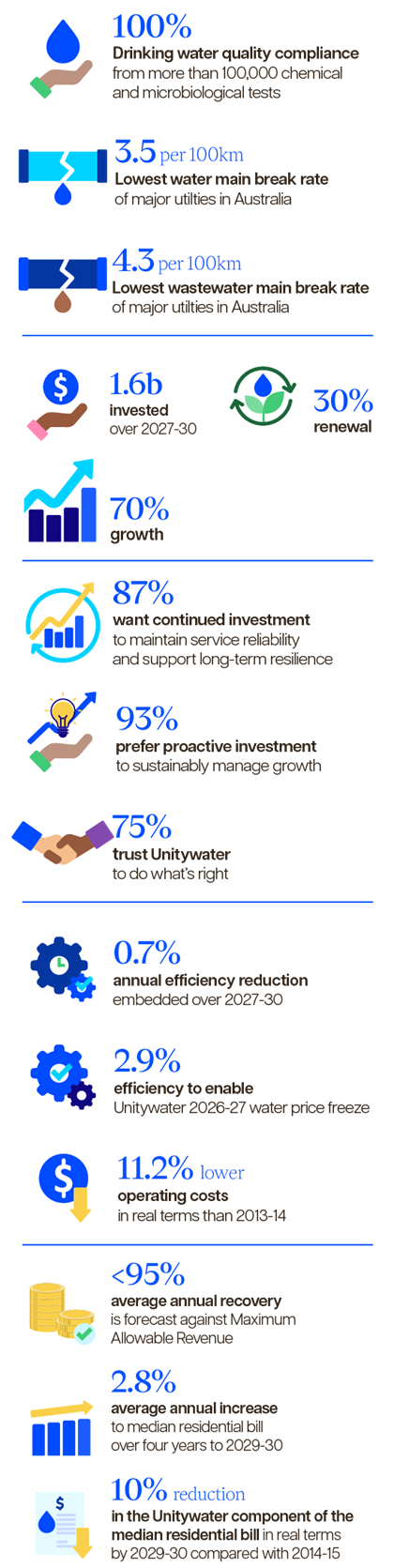
In 2025–26, we achieved 100% drinking water quality compliance, supported by more than 140,000 chemical and microbiological tests.
We will continue to provide safe, reliable and sustainable water and wastewater services, with 24/7 response and support
We’re forecasting continued strong network reliability and will keep monitoring and responding to faults and emergencies around the clock.
Our faults and emergency response is available 24/7, 365 days of the year, to keep your essential water and wastewater services flowing.
We will invest to maintain reliable service levels for current customers
We’re planning to invest over $1.6 billion in water and wastewater infrastructure between 2027–28 and 2029–30. Around 30% will renew existing infrastructure, helping keep water and wastewater services safe and reliable for current customers.
This investment helps us maintain the pipes, pumps, plants and other infrastructure our communities rely on every day.
We will invest to sustainably support growth and our customers of tomorrow
About 70% of our planned investment will support growth, including the pipes and plants needed to connect new homes and communities. Investing ahead of growth helps us provide the infrastructure our growing region will need while continuing to deliver reliable services for existing customers.
Our 2026 Initiatives Engagement Survey explored what matters most to customers, including service reliability, growth, resilience and affordability, and tested how customers would prefer Unitywater to balance investment now against the risks and costs associated with delaying investment.
See how customer feedback informed our submission
We will continue to run an efficient business
We’re forecasting a further 0.7% reduction in operating costs each year through productivity and efficiency improvements, on top of the 2.9% efficiency reduction already built into 2026–27.
In real terms, once adjusted for inflation, our operating costs per property are 11.2% lower than they were in 2013–14. That means our operating costs have fallen even after accounting for inflation.
Excluding bulk water prices, which are set by the Queensland Government, we have the lowest combined water and wastewater operating expenditure per connection in South East Queensland.
We will work to keep your bills as low, stable and sustainable as possible
We have kept our water access and usage charges at 2025–26 levels in 2026–27, and our Part 2 forecast keeps them at those levels in 2027–28.
The Queensland Government has frozen bulk water prices for 2026–27 and 2027–28. We pass this charge straight through to you, with no markup.
As a further check, our forecast revenue stays below the Maximum Allowable Revenue (MAR) benchmark in every year of the price monitoring period, averaging under 95% of what this methodology would allow. MAR is used to assess whether forecast revenue is reasonable; it does not set the prices customers pay.
Across the four years to 2029–30, the median residential bill across our region is forecast to increase by an average of 2.8% a year.
Our forecast price path
In June 2026, Unitywater announced its 2026–27 pricing, which included the full pass through of the Queensland Government’s two-year bulk water price freeze. Following a State Government request, we updated our pricing with a freeze on our own water access and usage charges, keeping those charges at 2025–26 levels.
Our Part 2 forecast price path maintains our water access and usage charges at those same levels in 2027–28. The forecast increase in the total residential bill in 2027–28 reflects changes to wastewater charges, not water access or usage charges.
| 2026–27 base year | 2027–28 | 2028–29 | 2029–30 | |
| Region-wide median residential bill | $1,804 | $1,850 | $1,912 | $1,980 |
| Change from previous year | 1.6% | 2.5% | 3.4% | 3.5% |
Note: Region-wide median residential bill figures are based on median residential consumption of 137 kL per year. Forecasts assume the bulk water price remains at $3.517 per kL through to 2029–30.
Across the three-year price monitoring period, this represents a cumulative increase of approximately 9.7%, or an average increase of around $59 a year or $15 per quarterly bill for the region-wide median residential customer.
Even after our forecast increases, the Unitywater component of the median residential bill in 2029–30 is expected to be around 10% lower in real terms than in 2014–15.
These figures are forecasts, not final prices. We set prices annually so we can consider the latest information before determining prices for the year ahead.
Learn more about how we set our prices
The forecasts also assume the current Seqwater bulk water price continues through to 2029–30 because a bulk water price path beyond the Queensland Government’s price freeze to 2027–28 is not currently available. This is a modelling assumption, not a forecast of Seqwater’s future prices. If the bulk water price changes, forecast customer bills will also change. We always pass bulk water charges directly through to customers without adding a markup or profit margin.
Why we need to invest
Unitywater’s service region is experiencing significant population and housing growth.
1. Responding to extraordinary growth
Queensland Government projections indicate our region will need to accommodate an additional 546,200 people and 215,600 dwellings by 2046. More recent projections indicate our service region is expected to account for the largest share of Australia’s total population growth between 2026 and 2041.
Unitywater is on track to provide water and wastewater for 255,7971 new dwellings in our region by 2046. Our target exceeds the Queensland Government’s ShapingSEQ 2023: South East Queensland Regional Plan for the City of Moreton Bay, Sunshine Coast and Noosa providing for 40,197 (18.6%) more new dwellings than the Plan’s target of 215,600.
2. Planning infrastructure ahead of growth
Around 40% of forecast growth is expected outside our existing connection areas, across at least 15 growth fronts. This means major water and wastewater infrastructure needs to be planned, funded and delivered before some new communities are fully established.
3. Investing in growth and reliable services
We forecast investing $1.6 billion between 2027–28 and 2029–30, with around 70% supporting growth. Investment is also required to renew existing infrastructure, maintain service standards and meet environmental, compliance and resilience requirements.
4. Funding growth sustainably
Developers contribute towards the infrastructure needed for growth, but these contributions do not cover the full upfront cost of delivering major infrastructure. We therefore need to balance developer contributions, customer prices, borrowing and the timing of investment to fund growth sustainably.
Keeping costs down and services reliable
Unitywater recognises that affordability matters to our customers. Our approach is to continue challenging our costs while maintaining the services customers rely on.
The previous QCA price monitoring review covered 2013–14 and 2014–15. In that review, the QCA found no evidence of an exercise of monopoly power, assessed our capital expenditure program as broadly prudent and efficient, and accepted 99.8% of our submitted operating expenditure as efficient.
Our benchmarking also shows we have the lowest combined water and wastewater operating expenditure per connection in South East Queensland, excluding bulk water costs . Since 2013–14, our operating costs per property have also fallen by 11.2% in real terms, while we have maintained strong service outcomes.
We also increased our operating expenditure efficiency target from 1.0% to 2.9% in 2026–27 to support holding our water access and usage charges at 2025–26 levels. Those savings are embedded in our forecast cost base, with a further 0.7% productivity and efficiency target applied in each year from 2027–28.
Unitywater enters this price monitoring period with a strong track record of service performance, cost control and price restraint. In 2024–25, key service performance indicators included:

100% drinking water quality compliance, supported by more than 100,000 chemical and microbiological tests each year.

3.5 water main breaks per 100 km, the lowest rate reported among Australia’s major utilities and well below the national median of 16.8.

4.3 wastewater main breaks and chokes per 100 km, also the lowest rate reported among Australia’s major utilities and significantly below the national median of 26.9.
Customer research also supports continued investment: 93% of customers prefer proactive investment to sustainably manage growth, 87% want continued investment to maintain service reliability and support long-term resilience, and 78% say they trust Unitywater to do what is right after considering our investment approach.
What is the QCA reviewing
On 24 September 2025, the Queensland Government directed the QCA to undertake a price monitoring investigation of Unitywater and Urban Utilities covering 1 July 2026 to 30 June 2030. The investigation is being undertaken in two parts. For Part 1, the QCA reviewed our 2026–27 forecasts and the systems and processes we use to plan expenditure, manage investment and identify efficiencies.
In its Interim Report, the QCA found that we had provided transparent revenue forecasts and documented planning and governance arrangements. It also noted proactive Board-level engagement on efficiency and a clear focus on customer affordability. The QCA found our overarching governance systems were robust, well documented and consistent with good industry practice, and described our capital planning, delivery and asset management systems as structured and mature.
Supported by its independent technical consultant, Utilities Regulation Australia, the QCA also found no material deficiencies in our frameworks or departures from good industry practice.
The more detailed assessment of whether our forecast expenditure is prudent and efficient is being undertaken through Part 2.
Read the QCA’s Part 1 Interim Report
For Part 2, the QCA is assessing our forecasts for 2027–28 to 2029–30, including:
- forecast prices, revenue and customer bill impacts
- productivity initiatives and efficiency targets built into our forecasts
- whether our forecast capital and operating expenditure is prudent and efficient
- whether service quality and reliability are expected to be maintained
- how actual revenue, prices and customer bill impacts will be reported against our forecasts.
The QCA provides independent scrutiny and transparency, but it does not set Unitywater’s annual customer prices through this investigation.
Our Part 2 submission also responds to relevant feedback from the QCA’s Part 1 Interim Report and provides further evidence about our expenditure forecasting, efficiency, customer engagement and governance arrangements.
Confidential information, including commercially sensitive material, has been redacted from Unitywater’s public submissions in accordance with the QCA’s confidentiality process, with complete, unredacted versions provided to the QCA for its review. For more information, see the QCA’s submission policy: https://www.qca.org.au/submission-policy/
QCA price monitoring investigation: key milestones
The QCA’s 2026–30 price monitoring investigation is being undertaken in two parts. These timelines show the key milestones from the Queensland Government’s referral through to the QCA’s final report. Dates are indicative and subject to change. For the latest information, visit the QCA’s price monitoring investigation webpage.
Part 1 – 2026–27
2026–27 forecasts and Unitywater's governance, planning, procurement, productivity and efficiency arrangements.

Queensland Government directs QCA to undertake the 2026–30 price monitoring investigation.

Focused on 2026–27 forecasts, governance and planning arrangements, productivity and efficiency.

QCA notes transparent revenue forecasts and robust, well-documented governance arrangements.
Part 2 – 2027–30
2027–28 to 2029–30 forecast prices and customer bill impacts, expenditure prudency and efficiency and expected service outcomes.
Covers 2027–28 to 2029–30 forecasts, including prices and bills, expenditure, efficiency and service outcomes.

Community and stakeholders can provide feedback to the QCA on Part 2 submissions.

QCA publishes its preliminary findings for consultation.
Stakeholders can respond to the QCA’s draft findings.
QCA publishes its final report following consideration by the Queensland Government.
What happens next
Now that the Part 2 submission is publicly available, the QCA will continue its independent assessment. Under the current investigation timetable:
- stakeholders can provide submissions to the QCA until 5 October 2026
- the QCA is expected to publish its draft report in December 2026
- submissions on the draft report are due by 19 February 2027
- the QCA is expected to provide its final report to the Queensland Government in April 2027, with publication expected in early May.
We will continue to engage with the QCA throughout the investigation and report actual revenue, prices and customer bill impacts during the price monitoring period so they can be compared with our forecasts.
QCA FAQs
No. They are forecasts for 2027–28 to 2029–30.
Unitywater reviews prices each year using the latest available information before setting prices for the following financial year. This means factors such as inflation, interest rates, investment requirements and future Seqwater bulk water prices can be reflected when actual prices are set.
The Queensland Government’s two-year freeze applies to the Seqwater bulk water price. Unitywater has also kept our water access and usage charges at 2025–26 levels in 2026–27, and our Part 2 forecast maintains those charges at the same levels in 2027–28.
Wastewater charges have not been frozen. They increased in 2026–27, contributing to a 1.6% increase in the region-wide median residential bill, and are forecast to increase again in 2027–28.
As a result, the region-wide median residential bill is forecast to increase by 2.5% in 2027–28. This reflects changes to wastewater charges only, which are needed to maintain reliable wastewater services and support investment in infrastructure for growth, renewal and compliance.
No. Actual bill impacts depend on factors including water use and where a customer lives.
There are also some differences between City of Moreton Bay, Sunshine Coast Council and Noosa Shire Council customers as we continue the gradual transition from the different tariff arrangements inherited from the former Councils towards a single residential price structure across our service region.
Maximum Allowable Revenue, or MAR, is a regulatory benchmark calculated using the QCA’s established framework. It brings together the efficient costs of providing water and wastewater services, including operating costs, infrastructure investment and financing costs, depreciation, working capital, tax and other adjustments.
For a business subject to full economic regulation, a regulator-approved revenue requirement of this kind would typically be used as the basis for setting or approving prices. Unitywater is subject to a price monitoring investigation rather than price determination, so we use MAR as a benchmark to assess whether our forecast revenue and prices are reasonable – it does not determine the prices we charge customers.
Our forecast revenue is below MAR in each year covered by the Part 2 submission, averaging less than 95% of the benchmark.
Find out more
For more information about our prices, bills, governance and the QCA price monitoring investigation, explore the links below.
Visit the QCA price monitoring investigation webpage
Read Unitywater's Part 1 QCA price monitoring submission
Read Unitywater's Part 2 QCA price monitoring submission
